

If you’ve ever looked at the price of a gold leaf sheet and wondered how something made of real gold can cost so little, here’s the short answer: it isn’t that gold leaf is cheap — it’s that each sheet contains almost no gold. Genuine gold leaf is hammered down to about 0.1 micron thick, roughly 500 to 1,000 times thinner than a human hair. At that thickness, a single sheet weighs only a few milligrams, so even though the gold itself is priced normally, the amount you’re paying for is tiny.
Here’s what actually drives the price you see — and where the real cost in gold leaf comes from.
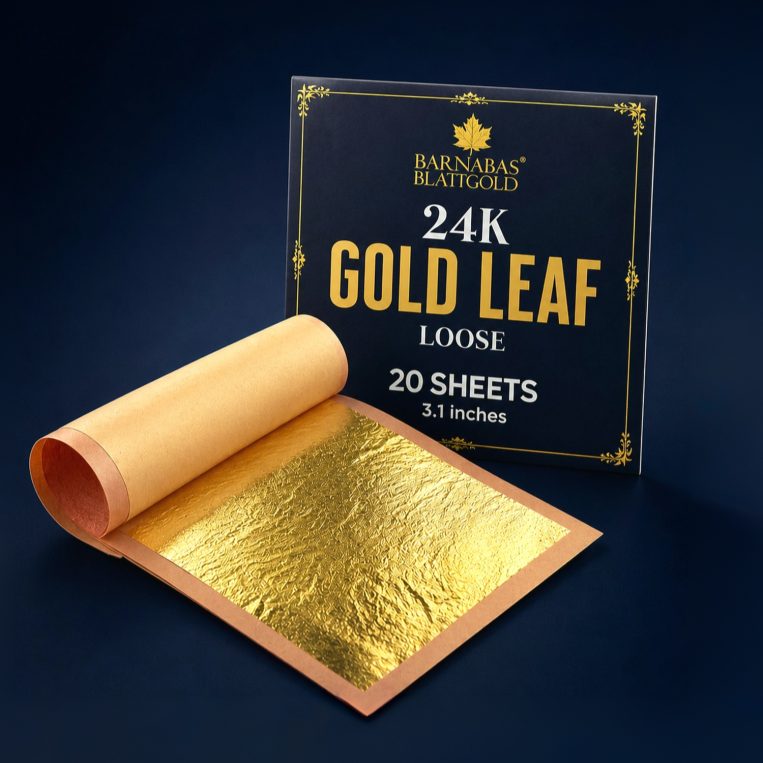
The Math: How Little Gold Is Actually in a Sheet
Gold is dense — about 19.3 grams per cubic centimeter — but leaf is beaten so thin that a standard 80mm × 80mm sheet contains roughly 12 milligrams of gold. That means:
- One troy ounce of gold (31.1 grams) can be beaten into around 2,500 sheets of that size.
- At a spot price of roughly $4,300 per troy ounce, the raw gold in a single sheet is worth about $1.70 to $2.
- The rest of what you pay for covers the goldbeating process itself — flattening gold to a uniform, hole-free micron-thin layer without tearing it is skilled, labor-intensive work, historically done by hand and still tightly controlled in modern production.
So when a sheet sells for a few dollars, you’re not getting a bargain on gold — you’re paying close to what the material and labor actually cost for an extremely small amount of metal.
Is Gold Leaf 100% Gold?
Not always, and this is the second big factor in price.
There’s real gold leaf — sheets, flakes, and edible gold — and there’s imitation gold leaf, which contains little or no actual gold. Imitation leaf is typically Dutch metal, a brass alloy of copper and zinc, and it is not food-safe. Only leaf explicitly manufactured and certified as food-grade — labeled E175 in the EU, or with equivalent food-safety documentation — should ever touch food. Always check the packaging and certification before consuming any metallic leaf; don’t assume “gold leaf” on a cake automatically means genuine, food-grade gold.
Imitation leaf is dramatically cheaper than genuine leaf for the obvious reason that it isn’t gold — which makes it a reasonable choice for decorative projects where authenticity doesn’t matter, but the wrong choice for anything edible or anything where tarnish resistance matters long-term.
So Is Gold Leaf Actually Expensive?
It depends entirely on scale and purity. A single sheet of genuine leaf is inexpensive in absolute terms because it contains so little gold. But buy in volume — a full booklet, a bulk order, or high-karat 24kt gold for a large gilding project — and the cost adds up the same way any gold purchase does, because you’re now buying a meaningful amount of the metal rather than milligrams of it.
Purity matters too. Gold leaf sold as an alloy (common in 12kt–18kt products) mixes in other metals, which lowers both the gold content and the price compared to 23kt or 24kt leaf. If your project needs tarnish resistance over time — outdoor gilding, jewelry, anything that will see handling or moisture — that’s worth paying for higher purity rather than optimizing purely for the lowest price per sheet.
The Bottom Line
Gold leaf isn’t cheap because gold got cheap — it’s cheap per sheet because each sheet is almost nothing but surface area. The moment you scale up, buy higher purity, or need certified food-grade or tarnish-resistant leaf, the price reflects that the material inside it is still real gold, priced like real gold.
FAQs
A standard 80mm sheet beaten to about 0.1 micron thick contains roughly 12 milligrams of gold — around 2,500 sheets from a single troy ounce.
Because it isn’t gold. Imitation leaf is typically a brass alloy (copper and zinc) treated to look like gold, so its price reflects base metal costs rather than gold’s spot price.
Generally yes. Higher-karat leaf (23kt, 24kt) contains a higher percentage of actual gold and less alloy, so it costs more per sheet than lower-karat leaf like 12kt or 18kt — but it also resists tarnishing better over time.
It can be, mainly due to certification and food-safety requirements rather than the gold content itself. Always confirm a product is certified food-grade (such as E175 in the EU) before using it on food — decorative leaf is not a safe substitute.
No — gold leaf is priced and sold as a finishing material, not an investment vehicle. Its value is tied to craftsmanship and usability for gilding, not resale as bullion.


